The KINGROCK kennel is owned by Kennel Club members & International Championship Show judges Chris Thomas & Graham Godfrey. Although they have judged extensively around the world Chris had not accepted overseas appointments since 1996, however, in 2014 they were delighted to accept an appointment to judge bulldogs at the World show, held in Helsinki, Finland. This was the first time they had judged abroad together for more than 20 years and in 2015 they judged together at the Bulldog Club of Spain's 30th Anniversary Show, held in Lloret de Mar. They have both judged Bulldogs and French Bulldogs at Crufts.
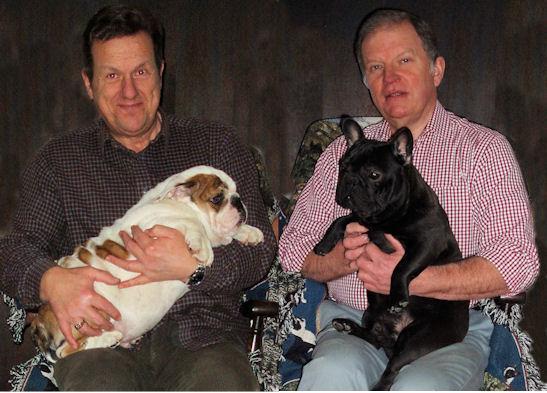
Chris with the bulldog puppy Kingrock The Democrat and Graham with the French Bulldog Kingrock Raimundo.
Chris was chairman of 'The British Bulldog Club' from 2010 until 2020. He is a past member of the Bulldog Breed Council's Health sub-committee and was also the Breed Council's Press Officer. Chris resigned both of these offices in light of the KC's publication of the new Bulldog Breed Standard (with it's 60 changes) during September 2009. He was then asked to stand again for the Breed Council's Health sub-committee at the AGM in 2013 and was honoured to be the only person standing to receive a vote from all of the 13 club's which participated.
Graham is a past member of the Breed Council Judges sub-committee and is a past member of The French Bulldog Club of England. He was also the French Bulldog representative to BUBA (British Utility Breeds Association) from which he retired in 2011.
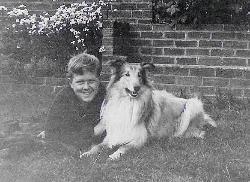
Chris' first show-dog, a Rough Collie, was purchased in 1965. He competed firstly in 'Junior Handling' classes and later in obedience competition. It was whilst attending shows that Chris saw his first Bulldogs and in 1975 purchased 'Chiansline White Regality of Kingrock'.
At that time the kennel was based in Luton in Bedfordshire and it was not until Chris was joined by Graham Godfrey, in the mid 80's, that it was decided to move the kennel from the South East to South Wales.
During the 7 years Chris and Graham resided in Wales they took over the running of the Bulldog Club of Wales, with Graham as secretary and Chris as Treasurer. When Chris resigned as treasurer he was honoured to be asked to become their President. Whilst in Wales they became Founder Members of the Utility Breeds Association of Wales. During this period Chris became the Bulldog Breed Note correspondent to the 'Dog World' newspaper.
In 1995 they left Great Frampton House, in the beautiful Vale of Glamorgan, and relocated to the hamlet of Counthorpe, South Lincolnshire. Following their move to Lincolnshire they became founder members of the 'Neapolitan Mastiff Club', with Graham as the club's first treasurer and Chris their first vice-chairman. They also became founder members of 'The Smooth Haired Dachshund Club'.
The Kingrocks have been resident at 'Counthorpe House' since 1995. The main part of the house was built in 1595, with the two 'wings' that can be seen to the front of the property, being added in 1773. The whole construction is of limestone, quarried less than a mile from the house. One of the kennel blocks can be seen to the right of the photograph.
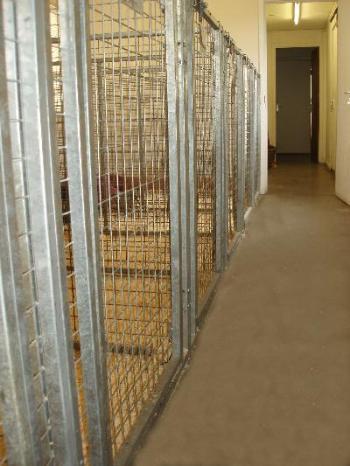
One of our indoor kennel blocks.
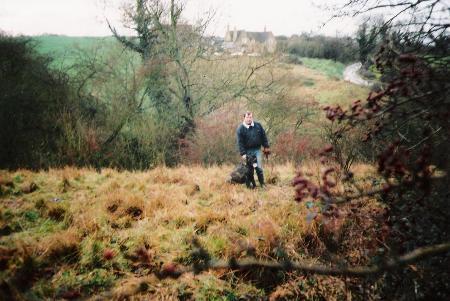
Graham, at the furthest point to which the land extends. The house can be seen in the distance and the wooded area to the left provides great fun for the dogs.
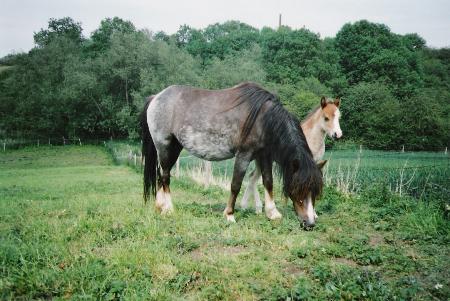
Two of the WELSH MOUNTAIN PONIES kept at Counthorpe. The foal, hiding behind her mother, is KINGROCK GOLDEN JUBILEE, who, perhaps not surprisingly, was born and registered during 2002, the year of our Queen's Golden Jubilee.
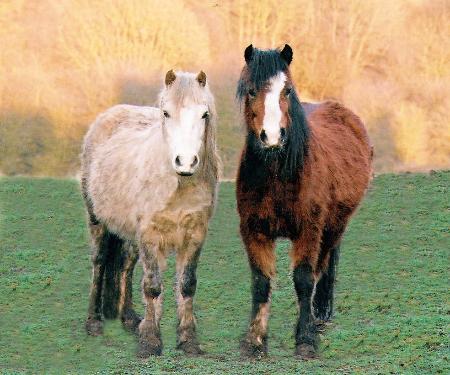
............and a couple more in their winter coats!
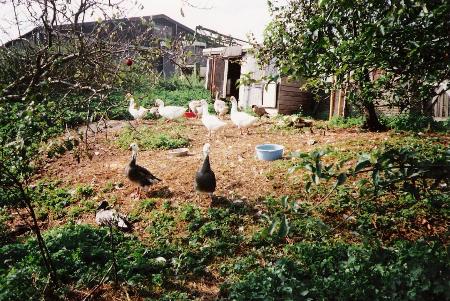
Some of the Ducks and Geese in their enclosure. Unfortunately, due to a problem with Foxes, they have to be closely watched.
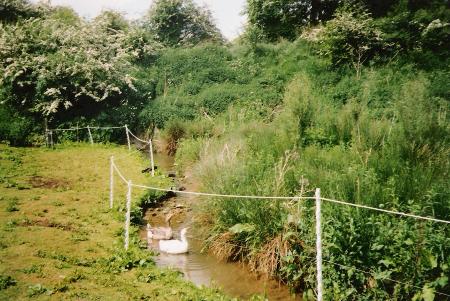
Geese on the stream which is fed from a natural spring and therefore rarely dries up
STAMFORD, our nearest town and one of particular interest to Bulldoggers.
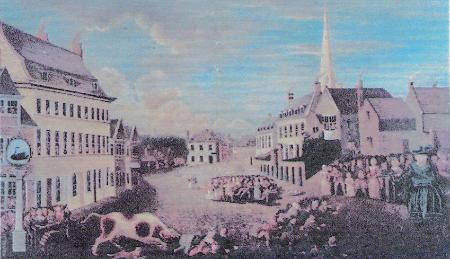
Those familiar with the history of the Bulldog will know that the tradition of bull-baiting started in the year 1209, during the reign of King John, when the Lord of Stamford, William de Warrene, observed from his castle wall two bulls fighting and witnessed the intervention of the local butcher with his dog to seperate them. One of the bulls escaped into the town centre, on a busy market day, and the Earl rode after the bull and so much enjoyed the spectacle, which involved local residents being thrown into the air, that he gave the meadow in front of the castle to the town's butchers so that they might provide a bull on St. Brice's Day (13th Nov.) each year for the continuation of the 'sport' forever.
In early references to the breed the bulldog is sometimes referred to as the 'Stamford Dog' and the painting below is of a 'Bull Running' in the town c.1800.
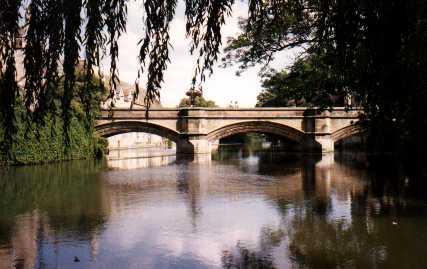
The day's 'sport' would start early in the morning when the Stamford Bellman would walk the town warning citizens and shopkeepers to stay indoors. At around noon the bull would be released and was then tormented and beaten with sticks by the crowd and chased through the streets. Exhausted, it would be led back through the town before being baited by dogs. It was then driven over the edge of the bridge into the river Welland before being dragged out and slaughtered. The meat was then distributed to the poor. Although of course the bridge has been replaced, it is still on the same site.
The bridge over the river Welland at Stamford
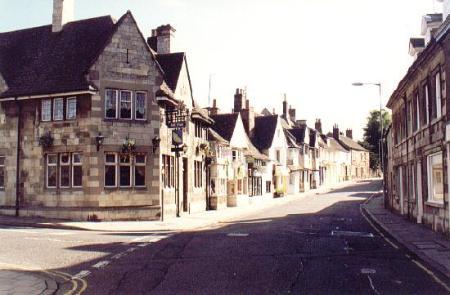
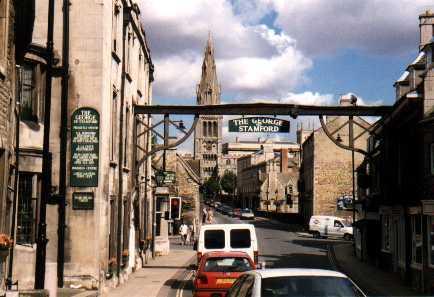
Stamford is considered to be one of the finest stone built towns in England. This is reflected in the number of tourists throughout the year, especially during the summer months. To Bulldog enthusiasts the history goes far deeper than the architecture, although it is an incredibly beautiful town. The photograph below is of the famous George Hotel which still has its gallows spanning the street. It also houses a very fine restaurant!





















 Chris' first show-dog, a Rough Collie, was purchased in 1965. He competed firstly in 'Junior Handling' classes and later in obedience competition. It was whilst attending shows that Chris saw his first Bulldogs and in 1975 purchased 'Chiansline White Regality of Kingrock'.
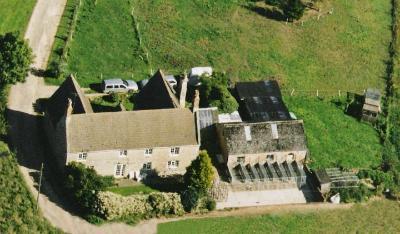 The Kingrocks have been resident at 'Counthorpe House' since 1995. The main part of the house was built in 1595, with the two 'wings' that can be seen to the front of the property, being added in 1773. The whole construction is of limestone, quarried less than a mile from the house. One of the kennel blocks can be seen to the right of the photograph.